
Home › Free Tests › Big Five › Compare
Big Five comparison tool
Compare Two Sets of Big Five Results
See how two personalities fit together. Enter both people’s Big Five scores to explore where you are alike, where you differ, and which differences are most likely to matter.
Free · For couples, friends, family and teams · No account needed
How it works
Three steps to compare two personalities
Compare yourself with a partner, a friend, a family member or a colleague. All you need is a Big Five report for each person.
Both people take the test
Each person takes the free Big Five personality test: 50 questions, under 10 minutes.
Screenshot both reports
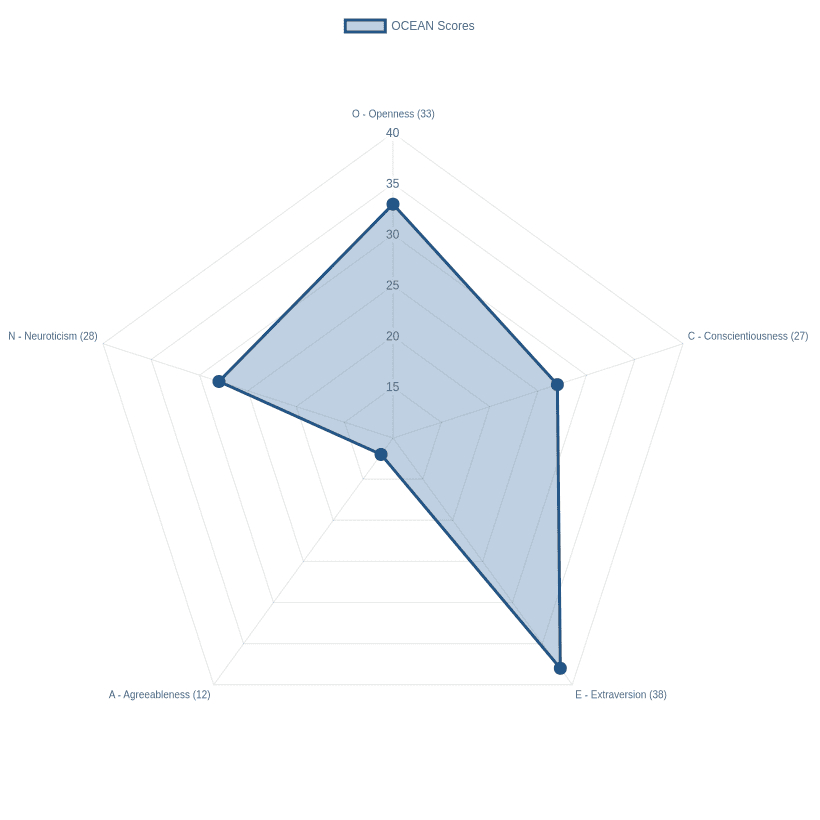
Each person should take a screenshot of their results page, so you have your five scores ready to enter below. If you didn’t enter an email address on the test, your scores can’t be recovered. See Where are my quiz results?
Enter both sets here
Add each person’s name and their five scores (0 to 40) below, and get an explanation of your similarities and differences.
Tip: your results report lists the traits in a different order from the comparison form. Match each score to its trait name, not its position, before you continue.
Personalized results, not a form letter
Most comparison tools just line up two sets of numbers. Your interpretation is written for your two exact profiles: where you’re likely to click, where friction may show up, and how to work with your differences.
The comparison tool
Compare your results
Have both reports ready. Enter each person’s name and their five trait scores exactly as they appear in their Big Five report.
What you’ll learn
What a Big Five comparison shows
The comparison looks at each trait side by side and highlights the patterns that most often shape how two people get along.
Common ground
Traits where your scores are close, which often feel easy and natural to share.
Complementary strengths
Differences that can balance each other, such as a planner paired with an improviser.
Possible friction
Large gaps that may lead to misunderstandings if you don’t talk about them openly.
Where to focus
Which differences are significant, and practical ideas for handling them well together.
Trait by trait
How each Big Five trait plays out between two people
A big gap on a trait is not a problem in itself. It simply shows where you may see the world differently, and where a little understanding goes a long way.
Openness
One person may crave new ideas, places and experiences while the other finds comfort in the familiar. This can show up in travel, hobbies, food and even conversation topics.
Try: take turns choosing, and look for experiences that feel new to one of you and safe to the other.
Conscientiousness
A planner and an improviser can make a great team, but gaps here often surface around chores, deadlines, money and punctuality.
Try: agree on a few non-negotiables, and give each other freedom everywhere else.
Extraversion
Differences in social energy affect how you like to spend evenings and weekends. One person recharges with people, the other with quiet.
Try: plan both social time and downtime, and treat recharging alone as a need, not a rejection.
Agreeableness
This trait shapes conflict style. A direct, competitive person and a harmony-seeking person can misread each other’s intentions in a disagreement.
Try: the more direct person softens the delivery, and the more accommodating person states their needs clearly.
Neuroticism
When one person worries more than the other, the calmer partner may seem dismissive and the more sensitive partner may seem to overreact.
Try: offer reassurance before solutions, and lean on the steadier person’s calm when stress runs high.
Differences are not deal-breakers
Compatibility depends far more on how two people handle their differences than on the differences themselves. Use your comparison to start a conversation, not to reach a verdict.
FAQ
Comparing Big Five results: common questions
Is the Big Five comparison tool free?
Yes. Both the Big Five personality test and the comparison tool are completely free, including your personalized interpretations, and neither requires an account.
What do I get from the comparison?
Not a form letter. You get an instant interpretation written for your two exact profiles: where you’re likely to click, where friction may show up, and how to work with your differences.
What do I need to compare results?
You need a Big Five report for each person from the Hypnotechs Big Five test, showing a score from 0 to 40 for each of the five traits, plus a name for each person.
Can I use scores from a different Big Five test?
For accurate results, both people should take the Hypnotechs Big Five test. Other tests use different questions and scoring scales, so their numbers are not directly comparable.
Who can I compare my results with?
Anyone who is willing to take the test: a partner, a friend, a parent, a sibling or a colleague. You can compare as many pairs as you like by running the tool again.
Can couples compare other results too?
Yes. Partners can also take the free Kappasinian Sexuality test and use the Kappasinian Sexuality Comparison to see how their Analytical and Physical styles fit together.
Can the Big Five predict whether a relationship will work?
No. Personality is only one part of any relationship. A comparison can highlight likely areas of ease and friction, but communication, shared values and commitment matter much more.
Is the comparison a clinical or counseling assessment?
No. The comparison is designed for self-reflection and conversation. It is not a substitute for relationship counseling or professional advice.
Haven’t taken the test yet?
Start with the free Big Five personality test: 50 questions, under 10 minutes, with a visual results report.
The Hypnotechs Big Five comparison is designed for self-reflection and conversation. It is not a clinical assessment or a substitute for professional relationship advice.