
Home › Learn › Spiegel Eye Roll Test
The Spiegel Eye Roll Test for Hypnotizability
A five-second physical test, developed by psychiatrist Dr. Herbert Spiegel, that estimates how readily a person can enter hypnosis — just by how far their eyes roll upward.
~5 sec
to perform
0–4
scoring scale
73.9%
reported correlation

What is the Spiegel Eye Roll Test?
The Spiegel Eye Roll Test (also called the Eye Roll Sign, or ERS) is a quick screening for hypnotizability. The person looks upward as far as they can and then slowly closes their eyelids. The amount of white of the eye (sclera) visible below the iris is scored from 0 to 4 — the higher the roll, the higher the person's likely trance capacity.
There are many different hypnotic susceptibility tests and scales, including the Stanford test, the Harvard Group Scale and the Kappasinian Suggestibility Assessment, among others, but none of them are a quick, single, physical step like the Spiegel Eye Roll Test for Hypnotic Susceptibility and Hypnotic Induction Profile as described by Dr. Spiegel.
Background
The Eye Roll Sign and innate trance capacity
Historical context
In four-thousand years of hypnosis research, we've only found one physical characteristic that shows a high correlation to hypnotic susceptibility. The Spiegel Eye Roll Test measures this phenomenon.
Dr. Herbert Spiegel, M.D.
In 1972, Dr. Herbert Spiegel, M.D. published "An Eye Roll Test for Hypnotizability" in the American Journal of Clinical Hypnosis, which detailed a method to determine trance capacity using the eyes. Across 2,000 consecutive cases, the eye roll correlated 73.9% with measured trance capacity — predicting hypnotizability in about three out of four people.
One physical trait
The subject is asked to roll their eyes back, much as if they were looking up through a hole in the hairline. The more the eyes roll up, the more susceptible the person is. The amount of roll is recorded on a scale of 0–4, with 4 being the most susceptible to hypnosis.
"The ability to look upward on signal while closing the eyelids (Eye Roll Sign) correlates highly (73.9%) with hypnotic trance capacity as measured by the Hypnotic Induction Profile in 2000 consecutive psychotherapy cases. In practical clinical terms this implies that in about five seconds the Eye Roll (ER) sign predicts hypnotizability in three out of four cases. Further, the higher the roll (0–4 scale), the higher is the trance capacity. This offers a quick, subtle, clinical way to ascertain whether or not hypnosis can have a probable role as an adjunct in the various psychotherapeutic strategies."
— Herbert Spiegel, M.D., "An Eye Roll Test for Hypnotizability," American Journal of Clinical Hypnosis (1972)
Step by step
How to do the eye roll test
This is the test procedure from the Hypnotic Induction Profile (HIP). The client is told to:
Hold your head looking straight forward.
While holding your head in that position, look upward toward your eyebrows — now toward the top of your head (Up-Gaze).
While continuing to look upward, at the same time close your eyelids slowly (Roll).
Now, open your eyes and let your eyes come back into focus.
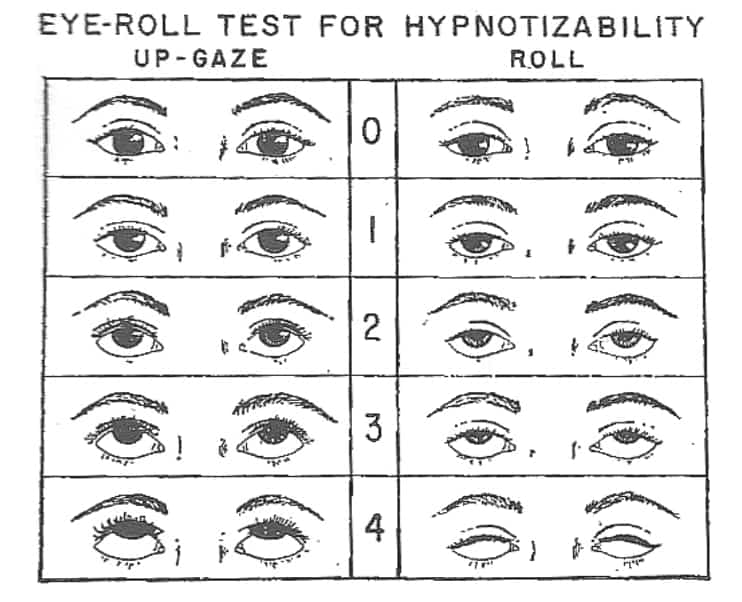
How it's scored
The Up-Gaze and Roll are scored on a 0-to-4 scale. The amount of sclera visible between the lower eyelid and the lower edge of the cornea is the most practical measurement.
Clinical use
The Hypnotic Induction Profile (HIP)
Administration of the Hypnotic Induction Profile (HIP) can be a routine part of the initial visit and evaluation. The test begins with the eye-roll sign, a presumptive measure of biological ability to experience dissociation. In the test procedure for eye-roll sign measurement, the patient is told "Hold your head looking straight forward; while holding your head in that position, look upward, toward your eyebrows, now toward the top of your head (up-gaze). While continuing to look upward, close your eyelids slowly (roll)."
The up-gaze and roll are scored on a 0-to-4 scale by observing the amount of sclera visible between the lower eyelid and the lower edge of the cornea. This procedure takes approximately 5 seconds. The eye roll is a part of the hypnotic induction, which is also scored as an initial indicator of the potential for hypnotic experience. Also, in many patients, the eye roll alone can become a spontaneous rapid hypnotic induction in addition to providing initial information that is compared to the more traditional perceptual and motor items that follow.


From the practice
A quick, discreet way to use it in session
If a subject is sitting in my office, facing me, I sometimes find it helpful to place my fingertip on their forehead, right about the hair line, then ask them to look up, through their forehead, at my finger. It's a super quick and very discreet way to estimate the results of the Spiegel Test on the fly. For standing subjects, I will often stand beside and just behind them to the right, just behind their shoulder, then place my index finger tip on their forehead, and ask them to roll their eyes up to look at it, while keeping their head still. It should be noted that either of these techniques can be combined with "eye fixation" techniques and can be used to induce hypnosis in many people, particularly somnambulists and high-physicals.
The research debate
Is the eye roll test accurate?
As with all theories, there are, of course, dissenting opinions. I have seen this correlation in my practice over the years, which is why I present it here, but there are those who argue the correlation is not as strong as claimed. While there are plenty of articles about the efficacy of the assessment, most of those who have objections to those claims point at a single 1982 paper. If you are interested in researching it further, you should start here: Illusion that the eye-roll sign is related to hypnotizability.
Go further
Your eye roll is just one clue — explore the rest
Get a fuller picture of how you respond to hypnosis with these free assessments and guides.
Trance Receptivity Index
See how you respond to focus, imagery, and relaxation — and which techniques suit you.
Take the test →Free testKappasinian Suggestibility
Find out whether you respond more to literal or inferred suggestions.
Take the test →Free testFocus & Trance State Profile
Map how you concentrate and enter absorbed states, so hypnosis can be tailored to you.
Take the test →GuideThe Lemon Test
Another simple, classic way to gauge how strongly you respond to suggestion.
Read the guide →FAQ
Eye roll test: frequently asked questions
What does a high eye roll score mean?
A higher score (3 or 4) means more of the white of the eye is visible below the iris as the eyelids close. According to Dr. Spiegel's research, the higher the roll, the higher the person's likely capacity for hypnotic trance.
Does a low score mean I can't be hypnotized?
No. The eye roll sign predicts hypnotizability in roughly three out of four cases, so it is an indicator, not a verdict. Many people with a modest eye roll still respond well to hypnosis, and other assessments can give a fuller picture.
Can I do the Spiegel test on myself?
You can't easily see your own eyes while they roll up and close, so it works best with a partner watching — or by recording yourself with a phone camera held at eye level and reviewing the video.
How long does the eye roll test take?
About five seconds. That speed is what makes it useful as a quick screening at the start of a hypnotherapy session.
Who created the eye roll test?
Psychiatrist Dr. Herbert Spiegel, M.D., who published "An Eye Roll Test for Hypnotizability" in the American Journal of Clinical Hypnosis in 1972. It forms the first step of his Hypnotic Induction Profile (HIP).
Keep learning
Go deeper into hypnosis
Explore how deep trance can go, the major approaches practitioners use, and recommended reading — or get answers to your questions in the Hypnotechs FAQ.