
Home › Learn › Maslow’s Hierarchy of Needs
The psychology of motivation
Maslow’s Hierarchy of Needs, Explained
Why do we do what we do? Abraham Maslow’s theory of motivation explains how our needs, from food and safety to belonging, esteem and self-actualization, shape our behavior. Here are the five levels with real-life examples, what Maslow actually said, and what the research shows.
5 levels · Real-life examples · Myths vs. facts · Video
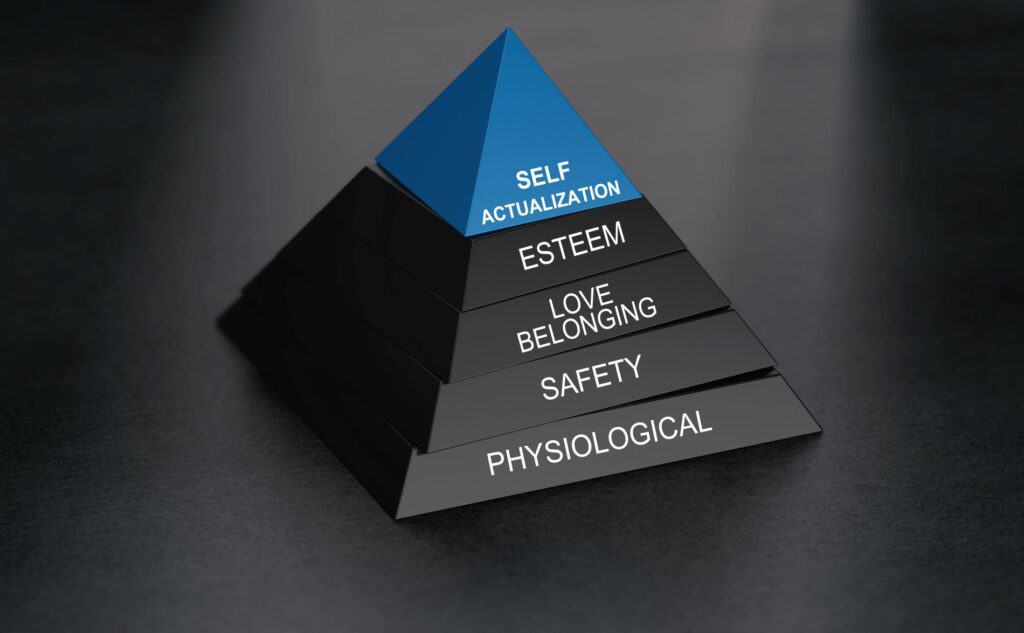
The five levels
What is Maslow’s hierarchy of needs?
Maslow’s hierarchy of needs is a theory of motivation proposed by psychologist Abraham Maslow in his 1943 paper “A Theory of Human Motivation”. It says people are driven by five kinds of needs, and that when a more basic need goes unmet, it tends to dominate our attention. As basic needs are satisfied, higher needs become more important.
The four lower levels are often called deficiency needs: we notice them most when they’re missing. The top level is a growth need: the more we pursue it, the more it motivates us.
Physiological needs
The foundation: the things the body needs to survive and function.
When it’s unmet: hunger, exhaustion or cold crowd out almost everything else. It’s hard to care about a promotion when you haven’t slept.
Safety needs
Protection, stability and a sense that the world is predictable.
When it’s unmet: anxiety and a constant focus on preventing loss. People may stay in jobs or situations that feel secure even when they’re unhappy.
Love and belonging needs
Maslow’s own name for this level. It’s about connection, acceptance and giving and receiving affection.
When it’s unmet: loneliness, social anxiety or trying too hard to fit in, such as people-pleasing to avoid rejection.
Esteem needs
Two sides: respect for yourself (dignity, achievement, mastery, independence) and respect from others (recognition, status, appreciation).
When it’s unmet: feelings of inferiority or weakness, or chasing approval and status to fill the gap.
Self-actualization
Becoming everything you’re capable of becoming. In Maslow’s words: “What a man can be, he must be.”
When it’s unmet: restlessness and a sense that something is missing, even when life looks fine on paper.
Myths vs. facts
What Maslow actually said
The famous pyramid has drifted a long way from Maslow’s writing. Four things most summaries get wrong:
Maslow drew the pyramid
He never did. The first known pyramid appeared in a 1960 business article by consulting psychologist Charles McDermid, and management textbooks made it famous.
You must complete one level before the next
Maslow wrote that most people are partially satisfied and partially unsatisfied in all their needs at once, and that behavior is usually driven by several needs together.
The order is the same for everyone
Maslow himself noted exceptions: some people value self-esteem above love, and some creative people pursue their work even when basic needs go unmet.
Self-actualization is the top
Later in his career, Maslow described a further motivation, self-transcendence: devotion to something beyond yourself, such as a cause, other people or spiritual experience.
The top of the hierarchy
What does a self-actualized person look like?
Maslow studied people he considered to be living up to their potential, including Abraham Lincoln, Albert Einstein and Eleanor Roosevelt, and described traits they shared. Self-actualization isn’t a finish line; it’s an ongoing way of living.
Clear view of reality
Comfortable with uncertainty and good at seeing through pretense.
Acceptance
Accepting of themselves, other people and human nature, flaws included.
Problem-centered
Focused on a mission or problem outside themselves rather than on their own ego.
Spontaneity and autonomy
Natural and independent, guided by their own values more than by social pressure.
Peak experiences
Moments of deep joy, awe or absorption that feel meaningful and transformative.
Deep relationships
A few very close bonds, plus a need for privacy and time alone.
Fresh appreciation
Still finding wonder in everyday things, however familiar.
Creativity and humor
Original in their thinking, with a thoughtful, unhostile sense of humor.
Watch
Maslow’s hierarchy of needs: the video
Putting it to use
Using the hierarchy for motivation and habit change
Many habits we want to change are really strategies for meeting a need. Hypnotherapists and coaches often look for the need behind a behavior, because meeting that need in a healthier way makes change much easier. For example:
Stress eating or smoking
Often a quick way to feel calm and safe. Lasting change usually means finding another way to feel secure and in control.
People-pleasing
Often driven by the need to belong. Building relationships where you feel accepted as you are reduces the pressure to please.
Overworking
Often a search for esteem or recognition. Building self-respect that doesn’t depend on output helps restore balance.
Try this
- Which need does my current habit meet for me?
- Which level is taking most of my energy right now?
- What would it look like to meet that need in a healthier way?
The research
Criticisms and what the research says
Maslow’s hierarchy is one of the best-known ideas in psychology, but it has important limits.
- The order isn’t strict. A study of 123 countries by Louis Tay and Ed Diener (2011) found that the needs Maslow described are broadly universal and linked to well-being, but people can enjoy good relationships and a sense of purpose even when basic needs aren’t fully met, and the order in which needs are met made little difference.
- Cultural bias. The model reflects an individualistic, Western view. In more collectivist cultures, belonging and community may matter more than personal self-fulfillment.
- Limited evidence for the levels. Studies have struggled to confirm five distinct levels satisfied in sequence.
- Too focused on the individual. Critics argue it underplays social needs, altruism and selfless acts, which don’t fit neatly into a ladder of personal needs.
- Little room for the unconscious. It says little about the unconscious motives and fears that psychodynamic theories emphasize.
None of this makes the theory useless. As a simple way to think about what drives behavior, and what someone may be missing, it remains a valuable starting point.
FAQ
Maslow’s hierarchy of needs: common questions
What is Maslow’s hierarchy of needs?
It is a theory of motivation proposed by psychologist Abraham Maslow in 1943. It says human behavior is driven by five kinds of needs, from basic survival to personal growth, and that unmet basic needs tend to take priority over higher ones.
What are the five levels of Maslow’s hierarchy in order?
From the bottom: physiological needs, safety needs, love and belonging, esteem, and self-actualization.
Did Maslow create the pyramid?
No. Maslow never drew a pyramid. The first known pyramid appeared in a 1960 business article by consulting psychologist Charles McDermid, and it spread through management textbooks.
Do you have to meet lower needs before higher ones?
Not strictly. Maslow wrote that people are usually partially satisfied in all their needs at once, and research suggests people can pursue belonging and purpose even when basic needs aren’t fully met.
What is self-actualization?
Self-actualization is the drive to become everything you are capable of becoming: to grow, create and use your talents fully. Maslow saw it as an ongoing process, not a final destination.
What are deficiency needs and growth needs?
Deficiency needs (physiological, safety, love and belonging, esteem) motivate us most when they are missing. Growth needs, such as self-actualization, motivate us more the more we pursue them.
Is there a sixth level above self-actualization?
Later in his career, Maslow described self-transcendence: devotion to something beyond yourself, such as a cause, other people or spiritual experience. Some modern versions of the hierarchy add it as a sixth level.
Is Maslow’s hierarchy supported by research?
Partly. Large studies find that the needs Maslow described are linked to well-being around the world, but not that they must be met in a fixed order. The theory is best used as a helpful framework rather than a strict rule.
What do you need from other people?
Explore your needs for belonging, influence and closeness with the free ICA Index, including an instant, personalized interpretation. Or see how much control you feel over your own life with the free Locus of Control Test.