
Home › Free Tests › Big Five
OCEAN · Five-factor model
Free Big Five Personality Test
Measure the five traits psychologists use most to describe personality: openness, conscientiousness, extraversion, agreeableness and neuroticism. Get a visual report of your scores, then compare your profile with a partner, friend or colleague.
Free · 50 questions · Under 10 minutes · No account needed

Why take this test
More than a score: a clear picture of your personality
The Big Five is the most widely researched model of personality in psychology. Our free test turns it into something you can actually use.
Research-based
Built on the five-factor model, tested in decades of studies across many cultures and languages.
Visual results report
See your profile as a radar chart plus a score for each trait, with a plain-language description of what it means.
Compare two people
Save your results and compare them with a partner, friend, parent or colleague to see where you align and differ.
Quick and free
50 questions, under 10 minutes. No payment and no account, just your first name and honest answers.
Personalized results, not a form letter
Most online tests give everyone the same canned paragraph for “high” or “low” on each trait. Your interpretation is written for your exact scores on all five traits and how they combine, so it describes you, not a category.
The assessment
Take the Big Five personality test
50 statements, under 10 minutes. Rate how well each one describes you, from 1 (disagree) to 5 (agree). Answer as you usually are, not as you wish to be, and go with your first instinct.
Your results
What your Big Five results look like
When you finish, you get a score from 0 to 40 for each trait, a label from low to high, a short description of what that level means, and a radar chart that shows the overall shape of your personality.
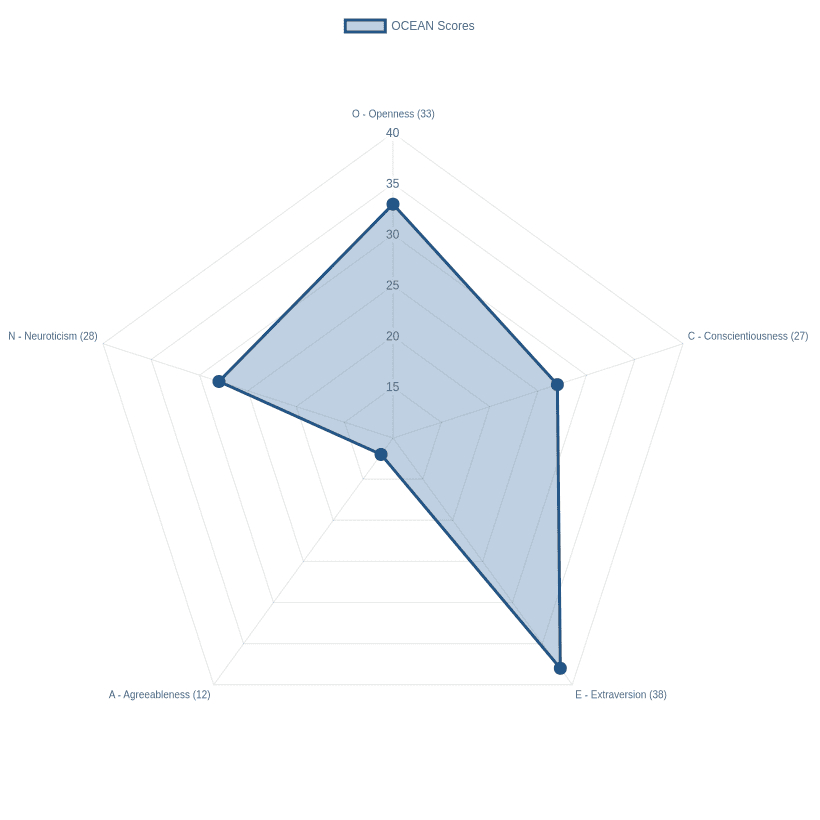
Your profile at a glance
The radar chart shows all five traits together, so you can see your personality’s overall shape.

Your trait breakdown
Each trait gets a score, a level and a plain-language summary of what it means for you.
Compare your results with someone else
Take the test, then have your partner, friend or colleague take it too. Enter both sets of results in our comparison tool to see your similarities, your differences and which ones matter most.
The five traits
The Big Five personality traits (OCEAN)
Each trait is a spectrum, not a box. Everyone falls somewhere between low and high on all five, and every level comes with its own strengths.
Openness
Curiosity and imagination
CConscientiousness
Organization and self-discipline
EExtraversion
Social energy and assertiveness
AAgreeableness
Compassion and cooperation
NNeuroticism
Emotional sensitivity
O
Trait 1
Openness to experience
Openness describes how drawn you are to new ideas, experiences, perspectives and creative expression. It captures curiosity, imagination and appreciation for art, beauty and complexity.
Higher openness
- Imaginative and intellectually curious
- Interested in art, music, literature or abstract ideas
- Comfortable exploring the unfamiliar
- Open to different viewpoints
- Drawn to variety and creativity
Lower openness
- Prefers familiar routines and practical solutions
- Values conventional, proven methods
- Likes clear, concrete information
- Appreciates predictability and consistency
A lower score does not mean a lack of intelligence or creativity. It often reflects a preference for practicality, familiarity and focus.
C
Trait 2
Conscientiousness
Conscientiousness reflects how organized, responsible, disciplined and goal-oriented you tend to be. It is about how you manage impulses, plans and commitments.
Higher conscientiousness
- Organized and dependable
- Punctual and thorough
- Careful when making decisions
- Motivated by achievement
- Plans ahead and follows through
Lower conscientiousness
- Comfortable with spontaneous decisions
- Prefers flexible schedules
- Works well in less structured settings
- Adapts plans as circumstances change
Higher is not automatically better. Flexibility and spontaneity are strengths in fast-changing or creative situations.
E
Trait 3
Extraversion
Extraversion measures your typical level of sociability, assertiveness, activity and positive emotional energy. It describes where you get your energy and how much stimulation you enjoy.
Higher extraversion
- Enjoys social interaction
- Energized by groups and conversation
- Communicates assertively
- Seeks stimulation and activity
- Expresses enthusiasm readily
Lower extraversion (introversion)
- Prefers small groups or one-to-one conversation
- Enjoys quiet environments
- Needs time alone to recharge
- Communicates reflectively
- Prefers less intense stimulation
Introversion is not shyness, and extraversion is not confidence. This trait is mainly about social energy and engagement.
A
Trait 4
Agreeableness
Agreeableness describes how strongly you emphasize cooperation, compassion, trust and consideration for others. It shapes how you handle relationships, conflict and competition.
Higher agreeableness
- Warm and compassionate
- Cooperative and accommodating
- Empathetic toward others
- Trusting and considerate
- Motivated to keep the peace
Lower agreeableness
- Questions other people’s motives
- Expresses disagreement directly
- Prioritizes competition or personal goals
- Takes a skeptical, challenging approach
A lower score does not mean unkind. It often reflects independence, directness and a willingness to challenge ideas.
N
Trait 5
Neuroticism (emotional sensitivity)
Neuroticism measures how strongly you tend to experience unpleasant emotions such as worry, sadness, frustration or irritability. Its opposite is often called emotional stability.
Higher neuroticism
- Feels stress and worry more readily
- Anticipates possible problems
- Reacts strongly to setbacks
- Notices threats and risks
- Experiences mood shifts
Lower neuroticism
- Emotionally steady
- Consistent moods
- Less everyday worry
- Stays calm under pressure
A higher score is not a weakness or a diagnosis. Emotional sensitivity often comes with empathy, caution and attention to what could go wrong.
The science
Where the Big Five comes from
The Big Five grew out of a simple idea known as the lexical hypothesis: if a personality difference matters in daily life, people will have invented words for it. In the 1930s, psychologists Gordon Allport and Henry Odbert combed the dictionary and listed thousands of English words describing personality.
Later researchers used a statistical method called factor analysis to find which of those descriptions tend to go together. Starting with Ernest Tupes and Raymond Christal in the early 1960s, study after study kept arriving at the same five broad clusters. Lewis Goldberg gave them the name “Big Five”, and Paul Costa and Robert McCrae developed the closely related five-factor model and questionnaires to measure it.
Today the Big Five is the most widely used framework in academic personality research. The five traits have been found in many languages and cultures, and they help researchers study everything from wellbeing and relationships to learning and work.
Is the Big Five personality test accurate?
The Big Five model is well supported by research, and well-designed Big Five questionnaires give consistent results over time. Any single result is still an estimate, and it can be influenced by:
- How honestly you answer
- How well you understand each statement
- Your mood and circumstances that day
- The length and wording of the questionnaire
- Cultural and language differences
For the most useful picture, answer as you usually are and treat your scores as a starting point for reflection.
Can your Big Five traits change?
Personality traits are fairly stable in adulthood, but they are not fixed. On average, people tend to become more conscientious and agreeable and less prone to negative emotions as they move from young adulthood into middle age, a pattern sometimes called the maturity principle. Life experiences, relationships, roles and deliberate effort can all shape how your traits develop.
Traits vs. types
Big Five vs. personality types
Trait models and type models answer different questions. Many people find it useful to explore both.
Big Five: how much of each trait
- Measures five traits on continuous scales
- Allows any combination of low, moderate and high scores
- The standard model in academic personality research
- Describes you rather than sorting you into a category
16 Paths: which type fits best
- Based on Jungian typology
- Describes four preferences that combine into one of 16 types
- Easy to remember and discuss with others
- Great for exploring motivation, communication and growth
FAQ
Big Five personality test: common questions
What are the Big Five personality traits?
The Big Five are openness to experience, conscientiousness, extraversion, agreeableness and neuroticism. Together they are known as the five-factor model of personality.
What does OCEAN stand for?
OCEAN is a memory aid for the five traits: Openness, Conscientiousness, Extraversion, Agreeableness and Neuroticism. Some people rearrange the letters as CANOE.
How long does the Big Five test take?
The test has 50 statements, and most people finish in under 10 minutes.
What do I get at the end of the test?
Not a form letter. As soon as you finish, you get your scores on all five traits plus an instant interpretation written for your exact profile, including how your traits combine, rather than a canned “high” or “low” paragraph for each one.
Is this Big Five test free?
Yes. Like all Hypnotechs assessments, the Big Five test is completely free, including your personalized interpretation, and you do not need to create an account to take it.
Can I compare my results with someone else?
Yes. Save your results (emailing them to yourself is easiest), have the other person take the test and save theirs, then enter both in our Big Five comparison tool.
Are high or low Big Five scores better?
No. There is no ideal profile. Each level of each trait has advantages and drawbacks depending on the person, the situation and their goals.
Can my Big Five traits change?
Traits are fairly stable in adulthood but not fixed. Age, life experiences, relationships and intentional effort can all shape how they develop and how you express them.
How is the Big Five different from type-based personality tests?
The Big Five measures how much of each trait you have on a continuous scale, while type-based systems such as the Myers-Briggs Type Indicator® (MBTI®) and our 16 Paths test place you into one of several types. The Big Five is the standard model in academic research; type models are popular for self-discovery and conversation. Hypnotechs is not affiliated with The Myers-Briggs Company or The Myers & Briggs Foundation; MBTI® is a trademark of The Myers & Briggs Foundation, Inc.
Is the Big Five test a psychological diagnosis?
No. This test is designed for self-reflection and education. It cannot diagnose mental health conditions or personality disorders; that requires a qualified professional.
Discover your OCEAN profile
50 questions, under 10 minutes, and a visual results report at the end. No account needed.
The Hypnotechs Big Five Personality Test is designed for self-reflection and education. It is not a clinical assessment and cannot diagnose any mental health condition.