
The Big Five Personality Test
Click Here to Compare Your Saved Results
Big Five Personality Test: Understand Your Personality Traits
Take the Test!
The Big Five Personality Test measures five broad dimensions of personality: Openness, Conscientiousness, Extraversion, Agreeableness, and Neuroticism. Together, these traits provide a research-based framework for understanding consistent patterns in how people think, feel, and behave.
Unlike personality systems that place people into fixed types, the Big Five model describes personality on a continuum. You can score anywhere from relatively low to relatively high on each trait, and your results may vary depending on your circumstances and life experiences.
What Does the Big Five Personality Test Measure?
1. Openness to Experience
Openness describes your interest in new ideas, experiences, perspectives, and forms of creative expression.
People with higher levels of openness may be:
- Imaginative and intellectually curious
- Interested in art, music, literature, or abstract ideas
- Comfortable exploring unfamiliar experiences
- Open to different viewpoints
- Drawn to variety and creativity
People with lower levels of openness may prefer:
- Familiar routines and practical solutions
- Conventional ideas and established methods
- Clear, concrete information
- Predictability and consistency
A lower score does not indicate a lack of intelligence or creativity. It may simply reflect a stronger preference for practicality, familiarity, and structure.
2. Conscientiousness
Conscientiousness reflects how organized, responsible, disciplined, and goal-oriented you tend to be.
People who score higher in conscientiousness may be:
- Organized and dependable
- Punctual and thorough
- Careful when making decisions
- Motivated by achievement
- More likely to plan ahead and follow through
People with lower levels of conscientiousness may be more comfortable with:
- Spontaneous decisions
- Flexible schedules
- Less structured environments
- Adapting plans as circumstances change
Conscientiousness is not the same as being “better” or more capable. Different levels may be useful in different situations.
3. Extraversion
Extraversion measures your typical level of sociability, assertiveness, activity, and positive emotional energy.
People with higher levels of extraversion may:
- Enjoy social interaction
- Feel energized by groups and conversation
- Communicate assertively
- Seek stimulation and activity
- Express enthusiasm readily
People with lower levels of extraversion, often described as more introverted, may prefer:
- Smaller groups or one-to-one conversations
- Quiet environments
- Time alone to recharge
- Reflective communication
- Less intense social stimulation
Introversion is not the same as shyness, and extraversion is not the same as confidence. These traits primarily describe patterns of social energy and engagement.
4. Agreeableness
Agreeableness describes how strongly you tend to emphasize cooperation, compassion, trust, and consideration for others.
People with higher levels of agreeableness may be:
- Warm and compassionate
- Cooperative and accommodating
- Empathetic toward other people
- Trusting and considerate
- Motivated to maintain harmony
People with lower levels of agreeableness may be more likely to:
- Question other people’s motives
- Express disagreement directly
- Prioritize competition or personal goals
- Take a more skeptical or challenging approach
A lower score does not automatically mean someone is unkind. It may reflect greater independence, directness, skepticism, or willingness to challenge others.
5. Neuroticism
Neuroticism measures individual differences in emotional sensitivity and the tendency to experience unpleasant emotions such as worry, sadness, frustration, or irritability.
People with higher levels of neuroticism may be more likely to:
- Experience stress or anxiety
- Worry about possible problems
- React strongly to setbacks
- Notice threats or potential risks
- Experience emotional fluctuations
People with lower levels of neuroticism may generally experience:
- Greater emotional stability
- More consistent moods
- Lower levels of everyday worry
- A calmer response to stressful situations
A high score does not define someone as weak or unhealthy. Emotional sensitivity can also be associated with careful risk awareness, empathy, and attention to problems.
How the Big Five Personality Model Works
The Big Five model does not place people into one of a small number of personality categories. Instead, it describes your position on five separate trait dimensions.
For example, someone might be:
- High in openness
- Moderate in conscientiousness
- Low in extraversion
- High in agreeableness
- Moderate in neuroticism
This approach recognizes that personality is complex. Two people may have similar scores on one trait while differing substantially across the other four.
What Can Big Five Personality Results Tell You?
A Big Five assessment may help you reflect on:
- Your preferred ways of working and communicating
- How you respond to change and uncertainty
- Your typical approach to planning and decision-making
- Your social preferences and energy levels
- How you manage stress and emotional pressure
- Your strengths, habits, and areas for personal development
- Possible patterns in relationships, education, or work
Personality results are most useful as a tool for self-reflection. They should not be treated as a diagnosis, a prediction of your future, or a complete description of who you are.
Is the Big Five Personality Test Accurate?
The Big Five is one of the most widely studied models of personality in psychology. Research generally supports the usefulness of the five-factor framework for describing broad and relatively stable personality differences.
Your results can also be influenced by:
- How honestly you answer
- How well you understand each question
- Your current mood and circumstances
- The wording and quality of the test
- Cultural and language differences
Personality traits describe tendencies, not fixed rules. People can behave differently across situations and may develop new habits over time.
Big Five Personality Test vs. Personality Types
The Big Five model differs from personality-type systems in several important ways:
- It measures traits on continuous scales rather than assigning a single type.
- It allows people to have any combination of high, moderate, or low scores.
- It is supported by a substantial body of psychological research.
- It focuses on describing personality rather than placing people into rigid categories.
This makes the Big Five useful for exploring individual differences without assuming that every person fits neatly into one label.
Frequently Asked Questions
What are the Big Five personality traits?
The Big Five personality traits are:
- Openness to Experience
- Conscientiousness
- Extraversion
- Agreeableness
- Neuroticism
They are also known as the five-factor model of personality.
Is the Big Five Personality Test free?
Like all Hypnotechs assessments, the Big Five test is available completely free of charge.
Is the Big Five test a psychological diagnosis?
No. The Big Five Personality Test is not a diagnostic tool and cannot diagnose mental health conditions or personality disorders. A qualified mental health professional is needed for clinical assessment.
Can personality traits change?
Personality traits are relatively stable, but they are not completely fixed. Life experiences, age, relationships, responsibilities, and intentional behavior change may influence how traits develop and how they are expressed.
Are high or low Big Five scores better?
No. There is no universally ideal Big Five profile. The usefulness of a trait level depends on the person, situation, goals, and environment.
The Big Five Personality Test offers a practical way to explore your individual patterns across five major personality dimensions. By understanding your scores, you may gain insight into your preferences, strengths, emotional responses, and interpersonal habits.
Use the results as a starting point for reflection—not as a permanent label. Personality is influenced by both enduring tendencies and the situations in which you live, work, and relate to other people.
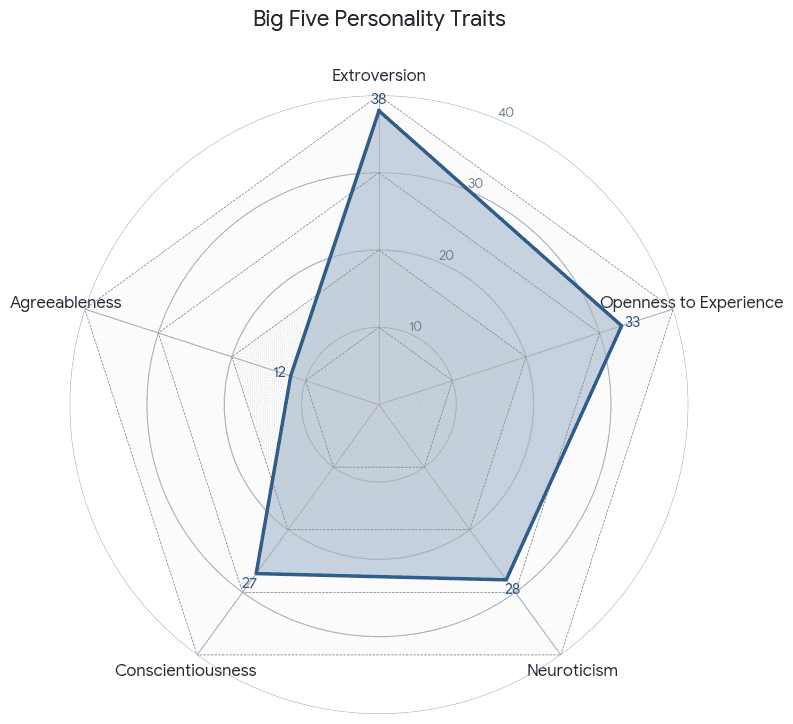
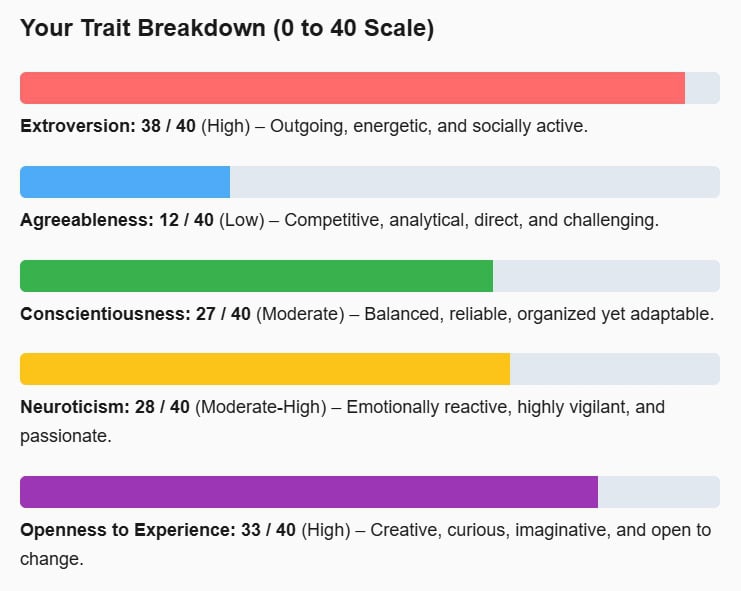
Example Results
Want More?
Visit the Quiz Section for more Assessments
Check out the Frequently Asked Questions section
Read the Blog
Ask “HypnoTex” a question
Or explore the rest of Hypnotechs.com